



America’s electrical grid is entering a decisive season. For most of the last century, demand for electrical power grew with the slow confidence of a mature nation: predictable, manageable, and largely invisible to the moral imagination of our politics.
That era is over.
A new wave of electrical hunger is reaching its zenith, driven by artificial intelligence, cathedral-sized data centers, industry, and the return of manufacturing to American soil. Demand is accelerating at a pace for which we have not planned. The result is a test of national identity and whether we can remain the world’s engine of innovation while still delivering the affordable, reliable, and increasingly clean energy that life demands.
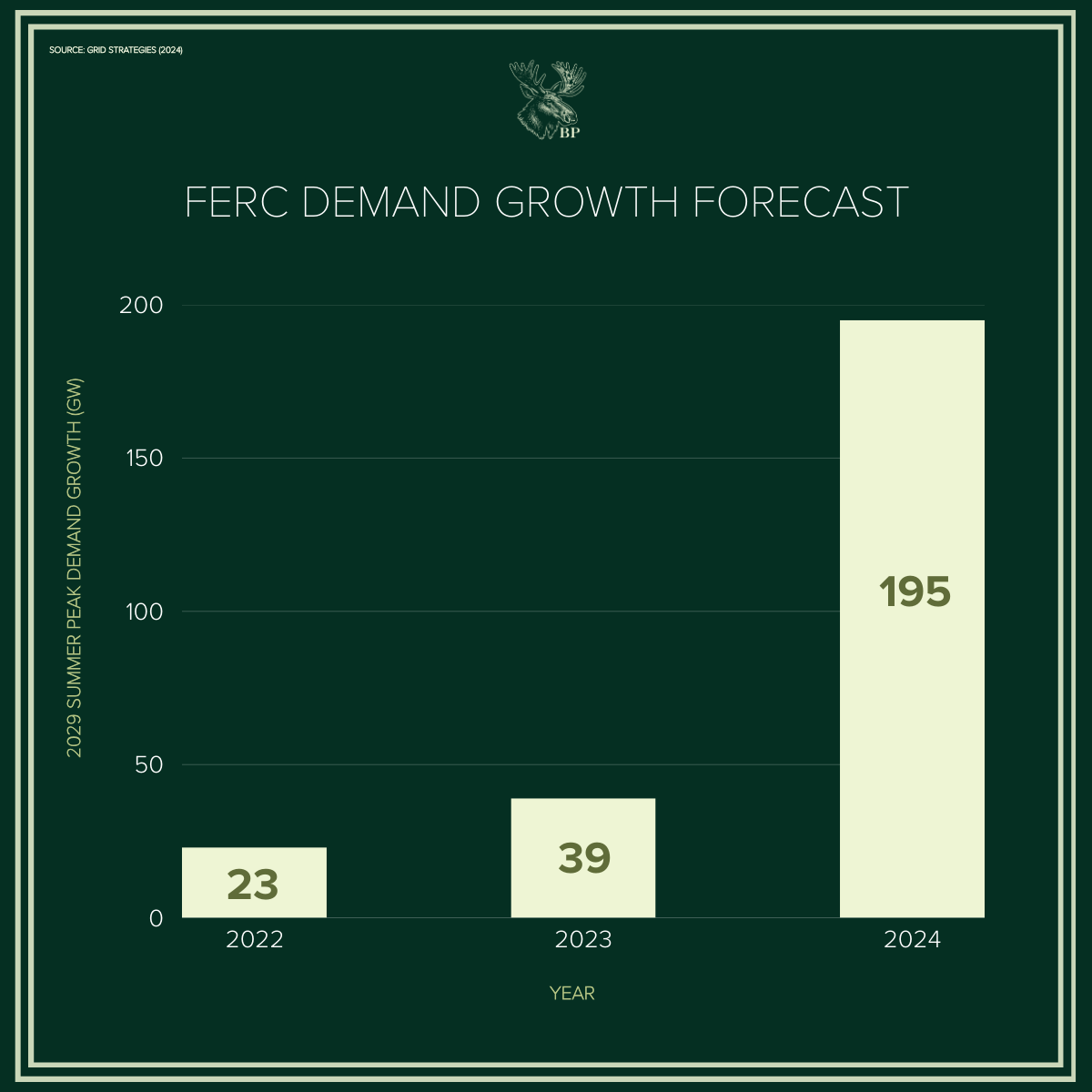
The raw numbers tell the story in plain terms; annual demand growth is expected to more than double the pace of the past two decades, forcing the system to attempt in roughly ten years what previously would unfold over thirty. Meeting that surge requires an expansion of both generation and transmission that is closer to wartime mobilization than normal grid planning: more planning, investment, and construction than precedented. Prices are already responding to the mismatch. In many regions, electricity costs have risen faster than inflation, and projections suggest sustained pressure if supply remains strangled by delay. The price of electricity means the difference between whether a young family can afford to live in their hometown, whether factories can reopen with confidence, and whether taxpayers will be asked to subsidize scarcity that our institutions could have prevented.
Yet we cannot respond to this moment by retreating from the technologies that cause it. Degrowth is never an option, especially now, when ceding the AI race to China would be a national security failure. The contest for AI leadership is a contest over military advantage, industrial capability, scientific primacy, and the shape of the global economy for the next half-century. Even those inclined toward (understandable) reflexive skepticism of tech should recognize the strategic reality. You might be tempted to wave AI off as an image generator and chatbot, applications I tend to disapprove of, but the truth is the country that leads in AI will write the rules of the digital frontier, and the country that lags will be governed by them.
The task before us is therefore not to choose between AI and energy affordability, or between innovation and stewardship. The task is to do both: to deploy AI rapidly and to power it with a grid that advances reliability and lower pollution for everyone else.
The encouraging news is that American ingenuity is already moving ahead of politics. Industry is beginning to stitch together solutions that meet the load surge without sacrificing reliability. Consider the agreement between Google and NextEra to restart Iowa’s Duane Arnold nuclear plant, shuttered after storm damage in 2020; Google will purchase most of the plant’s output under a long-term deal, with a local cooperative buying the rest on the same terms. The arrangement powers rising AI demand, strengthens regional reliability, and does so without shifting costs onto ordinary Iowans. It is a covenant between builders, a recognition that the digital economy and the energy economy are not separate realms, but two halves of the same national project.
Other examples point to the same spirit. Constellation Energy is exploring large-scale demand response, seeking roughly a gigawatt of flexible capacity by paying major customers to curtail briefly during grid stress. That is the equivalent of a full-size nuclear reactor in practical system value. Texas, facing its own load boom, is expanding similar flexibility programs to lower prices and keep reserve margins healthy as new data centers arrive. These efforts matter because they recover a truth that our regulatory order has oddly obscured: not all megawatts are equal. A megawatt that can bend temporarily, predictably, and contractually can be nearly as valuable as a megawatt newly built, especially in the short run, because it preserves reliability without imposing scarcity on the public.
There is, understandably, frustration in many communities about the arrival of data centers and the price pressure they create. Yet, AI is also forcing the hand of those who have long opposed permitting reform on both sides of the political aisle. The reality is that meeting this new demand unlocks something long out of reach: the political and financial will to build the new energy projects we have talked about for decades but have failed to deliver. With the right policy, data centers could become catalysts for energy abundance and lower costs. Moreover, they could become catalysts for the kind of expensive technological innovation and scaling that will lower emissions and improve environmental outcomes. Hyperscalers are putting real dollars behind nuclear, geothermal, and other clean technologies because energy is their number one limiting factor. In this sense, the very companies driving demand growth are also the ones most capable of underwriting the high capex infrastructure that the left wants for decarbonization and the right wants for prosperity. If we are wise, we will recognize this not as a burden, but as a once-in-a-generation alignment of incentives.
Policy, however, must not lag reality. A recent example of the kind of constructive middle ground we should celebrate is FERC’s Advanced Notice of Proposed Rulemaking (ANOPR) on the Interconnection of Large Loads to the Transmission System, which the Department of Energy encouraged under its Section 403 authority to propose rules for FERC’s consideration. Aside from jurisdictional disputes, the substance of the proposal has drawn praise across the spectrum, including a bipartisan push from Senate energy leaders pressing FERC to act and comments from us. The ANOPR formally recognizes load flexibility and co-location as system resources and offers faster interconnection pathways for projects that reliably provide those benefits. It also insists on a basic matter of justice. Large new loads should pay for one hundred percent of the grid upgrades assigned through their interconnection studies, since upgrades are a leading contributor to recent price increases. The public should not be forced to subsidize private expansion that strains a shared system.
Analysts have quantified how powerful flexibility can be if treated seriously. If large loads commit to even a one percent curtailment rate, only a few offline days per year, the grid could integrate on the order of one hundred gigawatts of additional capacity using existing infrastructure. That is not just a marginal gain. For that reason, we should welcome any credible tool, curtailment, co-location, faster interconnection, or better forecasting, that buys reliability and time. Neutrality toward solutions is wisdom in a moment like this. Flexibility can unlock the headroom we need at this moment.
That is where the moral clarity of abundance matters. Demand response is valuable. Co-location is valuable. Short-duration curtailment is valuable.
However, let’s be clear: none of them is a substitute for building.
The physical world does not yield to cleverness forever. If we attempt to manage a generational demand surge solely by stretching existing capacity tighter and tighter, we will replace abundance with a higher-tech version of scarcity: higher prices, more fragility, and a politics of rationing. A grid governed by delay and litigation cannot survive a decade of exponential load. The system needs breathing room, which means new generation, new technology, and new transmission to carry power from where it is produced to where it is needed.
Some will ask, reasonably, how this dramatic build-out of new power plants, transmission lines, substations, and everything else squares with the conservation mission we champion. It is true that abundant energy requires material inputs: steel, concrete, critical minerals, and the land to host new infrastructure. There are real trade-offs involved. Yet, we cannot ignore that meaningful conservation is downstream of prosperity. A nation that is cold, poor, and shrinking does not protect its landscapes; it strips them. Stewardship is only possible when a society has the resources and stability to care for what it inherits. The path to protecting the natural world runs through abundance, not austerity. Yes, this buildout will require tough conversations, common-sense community engagement, and a reckoning with trade-offs – but we cannot fall for the siren song of degrowth, of never-building, of perpetual stagnation.
Building at the speed this moment requires will demand two things we have been slow to provide: permitting reform and investment in next-generation power, especially clean, firm sources of electricity like nuclear fission, fusion, and geothermal, as well as grid-firming technologies like batteries. We cannot pretend that a grid built for yesterday’s load can serve tomorrow’s economy without a fundamental expansion of capacity. Permitting delays and interconnection backlogs are already turning projects into decade-long ordeals, and those timelines are irreconcilable with a demand curve steepening right now. If we want clean, reliable, affordable energy for American households, we must clear the procedural underbrush that keeps new generation and transmission from coming online.
We are at a tipping point that requires a robust grid that powers national strength, family life, and environmental stewardship. We cannot treat this demand as a threat to be ignored.
We must treat it as a summons to build the future.
Chris Barnard is the president of the American Conservation Coalition (ACC). Follow him on X @ChrisBarnardDL.
