



A few years ago, my wife and I purchased the forested acreage surrounding my childhood home. Deep in the forest on a hill were two large, rundown trailer campers the previous owner had dragged in there thirty years prior. They were an eyesore and, more importantly, a blight on the landscape full of plastics, chemicals, and stuff that just does not belong in the woods.
We were executing our forest management plan at the time and had hired a logger with a cable skidder to take out some large white pine trees nearing the end of their lives. I griped to our logger about the camper trailers and how I needed to make a plan to get them out of there. He shrugged and said he could drag them out that afternoon with the skidder for free; he liked our vision of the forest and agreed that they didn’t belong. It took him no time at all, and the forest is healthier for his efforts. This was probably one of the first real challenges my wife and I overcame with managing our forest.
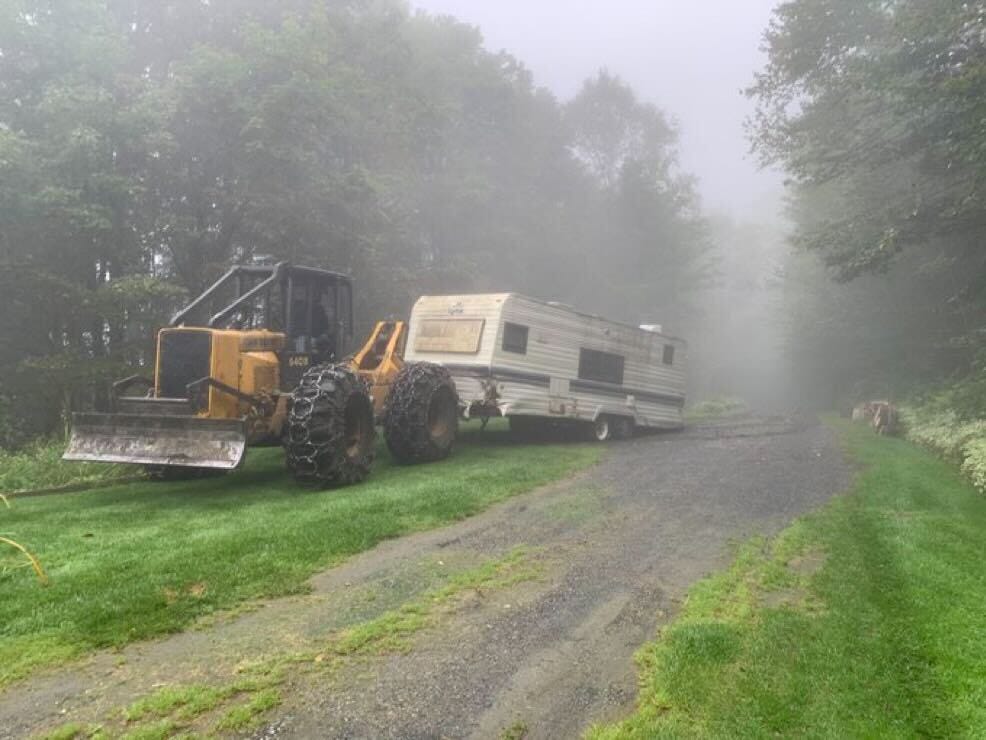
When I write about it online though, I inevitably receive a couple of comments stating naively that the project could have been done more sustainably with a couple of draft horses and a sledgehammer. I am always taken aback by these comments, as I imagine the absolute disaster dismantling those campers would have been for the environment; insulation, plastic particles, chemicals, and more would have become part of the ecosystem in my family’s forest forever. It’s hard for my online detractors to imagine, but a few gallons of diesel and one man’s labor were the most environmentally responsible solution here.
This causes me to reflect, though, on how we live in a moment increasingly animated by the anxious language of limits, where restraint is framed as moral clarity and less is presented as the responsible choice. The story of the skidder is a good parallel to these anxieties, and the naive degrowth-blighted mindset of “just use horses” is alive and well in the form of our reaction to new technologies as they arrive already burdened with suspicion. Artificial intelligence, in particular, is just the latest technology to be treated as a force that will hollow out work, displace judgment, and sever people from meaning before it has even been put to use. This anxiety is treated as wisdom, caution is praised as virtue, and the future is described as something to be managed downward rather than built toward. Luckily, the story and history of rural life in America offers a different inheritance: life in the country and on the frontier has always been shaped by applied ingenuity, faith in improvement, and a durable optimism sharpened by necessity.
Ultimately, when anxiety rises around new tools and unfamiliar systems, we need to discard hysteria and remember our rural American inheritance: test in the field, measure by consequence, keep what advances life and discard the rest.
As much as we like to romanticize the country idyll, rural life has never been preserved through sentiment. Farmers have always adopted new tools early because efficiency determined survival. Rural communities learned energy, water, and land management through daily use long before these subjects became abstract policy debates or crunchy lifestyle choices. Decisions were shaped by weather, margins, and time rather than theory and capitalism in these places functioned at a human scale. It rewarded innovations that produced results and quietly discarded the tools that failed. Pessimism or rampant anxiety had little purchase because it could not feed a family, power a mill, or carry a community through winter. Rather, progress emerged through trial, use, and retention while improvement was judged by real consequence. Tools spread because they solved problems, saved labor, reduced waste, and increased yield. Markets reinforced this discipline by sustaining those who adapted well and exposing those who did not. Like it or not, conservation and stewardship grew from the same pattern: productive land required care, water required management, soil demanded attention. Abundance followed from continuity, competence, and a willingness to test what was new without surrendering to fear. That inheritance remains instructive today. When unfamiliar tools arrive, the task is neither to romanticize the past nor to panic about the future, but to put them to work under real conditions and let results speak.
Energy follows this same logic. Power was never abstract in rural places. It was tied directly to work, continuity, and endurance. We like to romanticize a pre-electrified time, but when electricity reached farms and small towns, it arrived as relief rather than spectacle. Lights extended the working day, refrigeration stabilized food, motors replaced hours of manual labor, and Communication tightened bonds across distance. Electrification took hold because rural communities wanted it, invested in it, and organized around it, often building systems themselves when distant utilities or centralized efforts saw no profit in serving them; power succeeded where it was durable, affordable, and controlled close to the ground. Electricity was treated as infrastructure meant to last and aid in human flourishing, not a lever for some kind of centralized social planning. That same reasoning still governs how rural communities evaluate energy today. Systems are judged by reliability, cost, and whether they strengthen life over time. Clean energy fits within this tradition when it is developed with attention to place and consequence. Wind, solar, nuclear, storage, efficiency, and modern grid management function as tools within a working system, and adoption only follows performance. We can theorize all we want about the best systems, but at the end of the day, people in the country will look at you with a skeptical eye and say, “show me what it does.”
Modern cultural narratives often mischaracterize this history. Rural America is frequently portrayed as resistant to technological progress or hostile to innovation but truth be told, when our skepticism does justifiably appear, it is always aimed at abstraction rather than advancement. Systems imposed without regard for local conditions and human flourishing invite resistance, while degrowth arguments land poorly in places where survival has always depended on doing better over time. Asking communities to permanently accept less ignores the reality that abundance has historically been built through disciplined expansion and stewardship rather than some kind of centrally-managed scarcity.
Artificial intelligence is worthy of our skepticism but also belongs within this same evaluative tradition. Tractors once raised fears about labor, and electrification reshaped work without erasing it. Each tool extended human capacity while demanding judgment and responsibility. AI holds similar promise in agriculture, energy management, logistics, and land stewardship: predictive tools can reduce waste, precision systems can lower inputs, and smarter infrastructure can improve resilience. None of this means new tools are harmless however. Powerful technologies carry real risks because they amplify human intention, for good and for ill. Artificial intelligence can be used to manipulate, deceive, or centralize control just as machinery once displaced labor and industrial processes scarred landscapes when handled without restraint or virtue. Rural America has never been naïve about power but it has insisted on responsibility, demanded accountability, and corrected course when consequences became clear. The answer has never been paralysis. It has been a disciplined use guided by people who remain morally awake to what their tools can do.
American flourishing depends on recovering this way of thinking. Rural life has always required people to work under uncertainty, refine their methods through repetition, and prepare for futures they cannot fully predict. That habit produces abundance because it treats tomorrow as something worth investing in now. Clean energy, modern agriculture, conservation, and emerging technologies belong within this tradition when they are judged by use, consequence, and durability rather than ideology. What carries forward is not nostalgia but continuity: ingenuity applied where it matters, markets rewarding sound judgment, and optimism practiced through preparation. This is how a future capable of holding more people, more prosperity, and more life is actually built.
Ryan Anderson is the Stakeholder Communications Manager at the American Conservation Coalition (ACC) and the author of Echoes from an Old Hollow Tree. Follow him on X @OldHollowTree.
You are damn lucky. I had squatters on a piece of riverfront property. After spending the bucks to get them legally evicted, I got to pay for cleanup. 37 motorhomes and trailers to be removed. Sheriff had to sign off as there were no titles. I was a mile away from a transfer station. But first, we had to get them inspected for asbestos and get a statement that none was found. We need to make cleanup of junk like this easier, not harder.
Hey Ryan, I really appreciate your point of view. I think people need to at least grapple with optimism these days. Anyway, I think about the subject of this article a lot. My true love is growing things and making cider, but I still make my living as a software engineer. It’s something I’m usually embarrassed to admit to homesteader types, and the even worse thing is that I like it. I’m plenty skeptical of AI and I don’t think its ubiquity is taking us in a positive direction as a society, but it is a powerful tool and I use it. The trick is to use it surgically, which admittedly takes a lot of self discipline and reflection. But it absolutely has its value.
As an example, the USDA has a mindblowing database/catalog of soil types spanning the entirety of the US. The amount of detail and comprehensiveness is staggering (planning to write an essay on the history of it at some point). But the documentation is rough, and figuring out how to use it as an engineer is not intuitive. It’s also not geared towards your average person trying to understand the soil in an area. So now I’m working on a website that will allow people to get a comprehensive overview of a place and the soil and its natural capacity for farming, what it wants to be ecologically, etc. It’s only accessible to the average person because you can feed a crap-ton of raw data into an LLM, and have it construct a picture in language the average person can understand. Wendell Berry would probably still be appalled at me, but oh well.