


By Josh Smith, Energy Policy Lead at the Abundance Institute, and Sarah Rosa, Policy Director at the American Conservation Coalition
The United States is facing a massive and rapidly growing demand for electricity. As more aspects of daily life become electrified, manufacturing investments return to the U.S., and new technologies like artificial intelligence expand, the nation will need gigawatts of new power. Analysts at Grid Strategies, for example, project the country will require an additional 166 gigawatts by 2030.
This demand is striking not just for its size, but for how quickly it is arriving—and it may soon outpace our ability to supply it. Fortunately, states across the country are turning to a powerful solution: a new generation of advanced nuclear energy.
Nuclear Pioneers Are in State Capitols, Not Washington D.C.
While federal gridlock often dominates headlines, states are actively shaping the future of nuclear energy, pursuing a variety of strategies to unlock its potential. Utah provides a prime example of this forward-thinking approach. Governor Spencer Cox’s Operation Gigawatt is a bold initiative to double the state’s electricity-generating capacity over the next decade, with nuclear power playing a central role. The state also signed memoranda of understanding with nuclear industry leaders, forged a tri-state agreement with Idaho and Wyoming to strengthen regional collaboration, and established the Utah Nuclear Energy Consortium to focus its efforts—showing how states can drive real progress when federal action lags.
This momentum represents a nationwide movement. Louisiana, for example, released its Louisiana Advanced Nuclear Competitive Edge framework in collaboration with experts at Idaho National Laboratory, laying out a roadmap to expand nuclear development in the state. Pennsylvania’s Governor Josh Shapiro applauded and defended the new life of Three Mile Island as the Crane Clean Energy Center. He went so far as to ask the grid operators to fast-track its restart. In Texas, the state established the Texas Advanced Nuclear Energy Office, supported by a $350 million fund to accelerate nuclear innovation.
Utah, Texas, Louisiana, and Pennsylvania are among the leaders driving this effort. Across the country, state legislatures are taking action. In fact, the National Conference of State Legislatures’ State Energy Legislation Database reports 254 bills related to nuclear energy and nuclear waste were introduced in 2025, reflecting the growing recognition that states can–and must–play a central role in the nation’s clean energy future.
New Nuclear Plants Used to take 5 years and cost $1 Billion
Building new nuclear plants in the United States used to be fast, affordable, and reliable. The Connecticut Yankee plant, for example, came online in 1968 after only about five years of construction at a cost of around $1 billion in today’s dollars. For decades, building nuclear plants swiftly, safely, and cheaply was the norm.
Today, the story is very different. The recently completed Vogtle reactors in Georgia took 14 years to build and cost over $30 billion. The technology itself isn’t to blame; outdated federal regulations are the real obstacle. Rules developed over the last 50 years–based on principles like “as low as reasonably achievable” (ALARA) and the Linear No-Threshold (LNT) model–have created a system where even small regulatory changes can dramatically escalate costs and timelines. As one nuclear engineer explained, under ALARA, “the criteria is not whether the benefit of further reduction outweighs the cost. The criteria is: can you afford the reduction?”
The LNT model is particularly problematic: it originated from nearly 100-year-old experiments on fruit flies and assumes that any radiation, no matter how small, is harmful. This outdated approach ignores evidence that low-dose exposures are unlikely to cause adverse health effects, yet it continues to drive strict regulations that slow and inflate the cost of building new nuclear plants.
The result is clear: federal policies are slowing nuclear progress at exactly the moment when the nation needs new, reliable, affordable, and increasingly cleaner electricity. This is where states can make a difference. By creating clear, predictable regulatory pathways and coordinating with industry and regional partners, states can accelerate the deployment of new nuclear plants.
State Policies to Power a Nuclear Future
Of course, states haven’t fully enabled nuclear power yet. Some have moratoriums or restrictive policies that limit nuclear development. But the examples above show that states don’t have to wait for the federal government—when they decide to act, they can move quickly, drive innovation, and deliver reliable, affordable energy to their communities.
Far from being powerless, states have a wide range of policy tools to advance nuclear energy development.
Eliminate bans or differential treatment of nuclear energy more burdensome than those applied to other energy facilities.
Establish a state nuclear coordinator to act as the state’s internal advocate for nuclear energy. This office would work with companies on permitting, siting, federal coordination, and community engagement, while reporting to the legislature and others on statutory gaps, workforce needs, and overall progress.
Streamline permitting for new nuclear facilities, especially where existing generators are approaching retirement, where industrial users could use on-site generation, or where the transmission system has slack capacity that could be used more often.
Address workforce gaps in partnership with industry and academia, as Texas did in Texas Senate Bill 1535.
Classify nuclear energy as a clean energy source in recognition of its environmental benefits. An example here is Colorado, which added nuclear to its definition of renewable in 2025.
Why States Are Turning to Nuclear Energy
States are looking to nuclear energy for its combined reliability and safety. In fact, nuclear energy is one of the safest energy sources on the planet. For every terawatt-hour of electricity produced, nuclear power is associated with just 0.03 deaths, compared with 24.62 for coal—making coal over 800 times deadlier. Fears often focus on Fukushima, Three Mile Island, and Chernobyl, but these are misunderstood. Fukushima had only one death attributed to the disaster, Three Mile Island had no fatalities, and Chernobyl’s disaster was due to a flawed Soviet design.
Even safety concerns about nuclear waste are overstated. All U.S. commercial nuclear waste since the 1950s could fit on a single football field, and a person’s lifetime electricity needs would produce only a soda-can-sized amount. Far from a threat, nuclear energy is safe, clean, reliable, and increasingly beneficial to society.
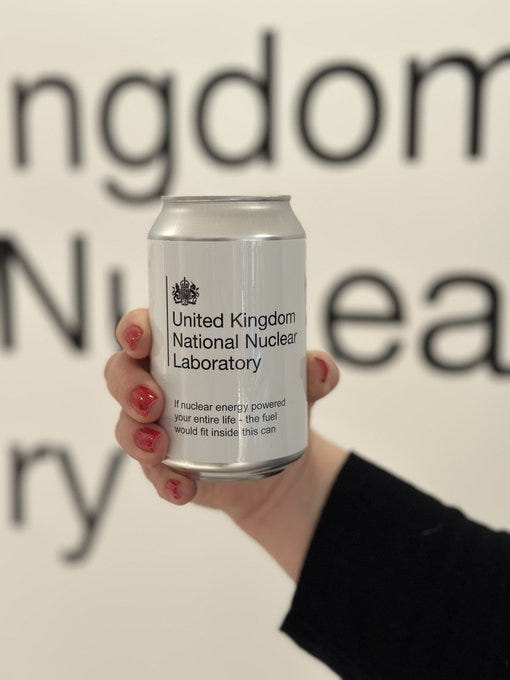
Beyond safety, nuclear power is also exceptionally reliable. It has a capacity factor of over 90%, the highest of any energy source, allowing it to produce electricity 24 hours a day, 7 days a week, 365 days per year.
Are We Ready for Nuclear Energy Abundance?
A new generation of advanced nuclear reactors is upon us, and state governments are leading the charge to deploy them. Long-held fears about nuclear power—from safety to radiation to waste—are based on outdated information and regulations that have not kept pace with modern science.
States will be a vital player in the next steps of America’s nuclear energy development. A critical ingredient is reforming decades-old federal regulations—like the LNT model—that stifle the very innovation these states are trying to unleash. Yet states shouldn’t wait. Federal action may well be spurred by the continued efforts of states like Utah and Louisiana to ready themselves for a new atomic age.
Josh T. Smith is the Energy Policy Lead at the Abundance Institute. Sarah Rosa is the Policy Director at the American Conservation Coalition.
The contrast betwen Connecticut Yankee (5 years, $1B) and Vogtle (14 years, $30B) is brutal. Federal regs built on 100-year-old fruit fly experiments holding back real progress while states like Utah and Louisiana are just moving ahead anyway. The state coordinator idea is smart, gives someone at the state level clear accountability for cutting through the noise and actualy moving projects forward instead of endless process loops.