


By Lucero Cantu, Creative Director at the American Conservation Coalition
Every few weeks in my neighborhood, the same ritual repeats.
A storefront window is shattered overnight, and by morning, a dejected owner throws up the plywood. A quick Sorry for the Inconvenience! is taped to the door. A few days later, shiny new glass. A few weeks after that, the 7-11 gets hit. Next month, it will be the Japanese market down the block.
No one is surprised anymore. Yes, frustration is there, from business owners, compassionate residents, but it’s resigned. The damage feels ownerless, not due to an unrecognizable, supernatural force. No, this force is man-made.
Neglect is a slow, creeping energy that happens one broken window at a time, chipping away at the belief that our communities are worth protecting in the first place. Beauty cannot coexist with neglect. The two are inherently repellent forces.
One can mitigate decay without prioritizing beauty, of course. This looks like increased policing, enforced codes, and constrained expression. While efficiency underlines this method, so does a lack of vision. When there is no hope, all that is left strong enough to mobilize people en masse is rage; a culture fueled by frustrations rather than a vision for a better future.
As it stands, beauty is treated as a decorative afterthought to conservatism despite the inherent contradiction. We cannot conserve what is good, true, or inherited if we no longer believe it is beautiful enough to defend.
There is a pervasive myth that the “serious” folk deal in power and pain, leaving beauty for the unserious. This flattening of what it means to protect and proliferate the beautiful ignores the morally significant power of beauty to captivate and pull our attention away from ourselves. This admiration shatters our ego and redirects our gaze toward a world bigger than ourselves. Maybe even better?
A person, a poem, a landscape. Once we love something beautiful, we want it to endure, and we want it to be known. Beauty, by design, prompts protection and distribution. We invite others to see a painting, hike our favorite trail, or visit the hidden gem with the best barbecue. Beauty expands our circle of concern and care for one another.
Policy is not the operative force behind the conservative instinct toward stewardship. The need to conserve our country and leave it in a better place for future generations comes from affection. It is love provoking the conviction that something is magnificent enough to safeguard. The early days of the American conservation movement understood that implicitly.
Conservation began as an act of aesthetic conviction.
“Here is your country. Cherish these natural wonders, cherish the natural resources, cherish the history and romance as a sacred heritage, for your children and your children’s children. Do not let selfish men or greedy interests skin your country of its beauty, its riches or its romance,” declared President Theodore Roosevelt after designating 230 million acres of public land to what is now known as the modern-day National Parks Service. The framing of these early federal victories focused on awe and beauty, not policy and, very rarely, efficiency.
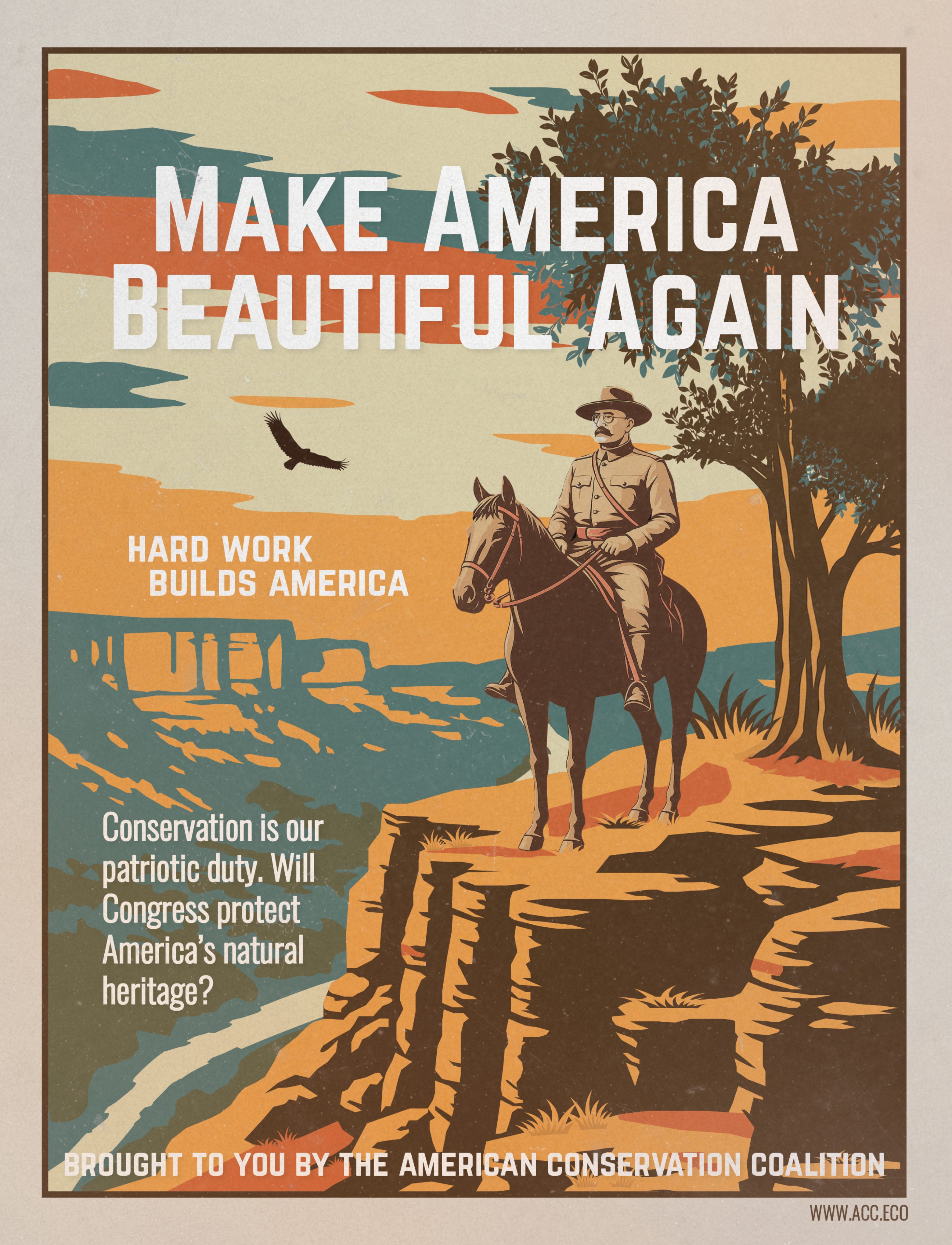
This week in Washington, D.C., a large print ad commissioned by the American Conservation Coalition went up on the side of a building depicting a horse-riding Roosevelt overlooking the landscape that bears his name. The design intentionally draws from the visual language originated by the 1930s National Park Poster series commissioned by the Works Progress Administration (WPA). Nearly a century later, those bold compositions– shaped by the Bauhaus, European Modernism, and limitations with silkscreen printing– still anchor conservation in the American imagination. Revisiting this language in 2026 is a declaration that conserving what is beautiful is the most reliable path to inspiring a culture of stewardship that goes beyond nature.
Many conservatives today are deeply attuned to the aesthetics of cultural drift. We see our civic spaces devolve to brutalism, the “inspired” art that favors irony over meaning. Commentators will flock to the Internet, declaring cultural decline at the sight of these choices. The diagnosis is often right, but culture needs more than critique to move forward.
Culture shifts when people are brave enough to push a compelling vision of society forward. A song, a film, or even a single image to remind people what inspiration feels like. A legacy built to last is one fortified by admiration. If beauty is the engine of care, then a culture of stewardship requires more than a policy platform. We must provide the public with ample reminders that what they are protecting is sublime.
Our national parks are magnificent.
Our freedoms are glorious.
Our citizens are inspiring.
Neglect is patient, always lying in wait for lowered expectations. When we stop creating beautiful things, we quietly concede that nothing around us rises above bare minimum maintenance.
Lucero Cantu is the Creative Director at the American Conservation Coalition.
Thank you! I changed the words to a song.
Oh, give me a home, where the butterflies roam.
Where the bees and the dragonflies play.
Where often is heard, an encouraging bird,
And the flowers are blooming all day.
Neglect is also apparent in our dress. In a few generations we have lost so much knowledge on how to dress well. We must strive to dress beautifully, build beautiful things, and live in beautiful places.