


By Benjamin Sission, Graduate Student in Ecology
My wife and I first encountered paintings from the Hudson River School of Art when touring the Broadmoor Hotel in Colorado Springs, CO. Neither of us knew diddly squat about art history or the philosophy of art (or aesthetics) at the time, but we were spellbound by the landscapes depicted by painters like Albert Bierstadt, Thomas Moran, Frederic Edwin Church, and others. A picture might be worth a thousand words, but great art communicates beyond words. Etienne Gilson, a Thomistic philosopher, quotes the French painter Eugene Delacroix to make this point: “The beauty of this art [painting] consists in the things that language is not able to explain.” Still, we can spill plenty of ink attempting to describe why beauty moves us, and why our response matters.
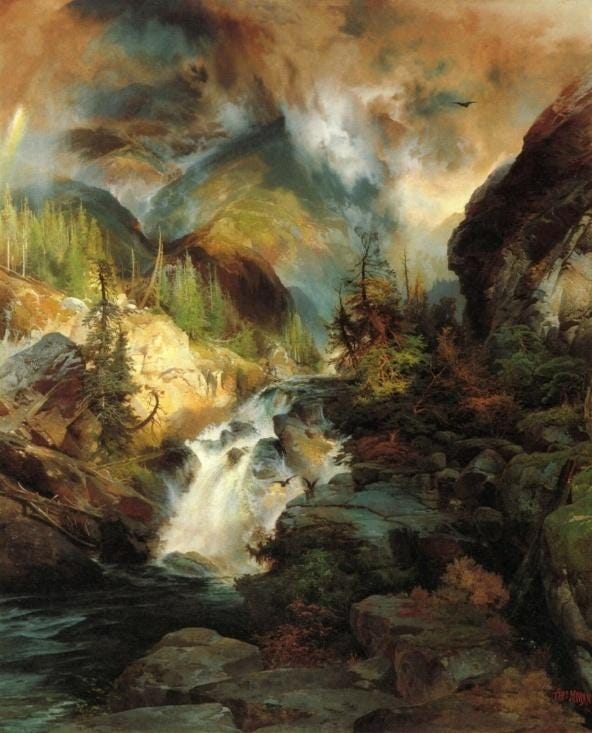
The Hudson River School was the first distinctly American art movement, coinciding generally with westward expansion. When it began in the 1820s, the fur trade was still in full swing, St. Louis, Missouri, had a population under 5,000, and grizzly bears still roamed as far east as modern-day Bismarck, North Dakota. The awe-inspiring paintings enchanted the American imagination for most of the century. By the time the Hudson River School’s prominence declined in the 1880s, a railroad ran coast to coast, telegraph lines enabled near-instant global communication, the millions-strong bison herds were well on their way to extirpation, and St. Louis’s population had ballooned to over 350,000. Thomas Cole began the movement, whose early work depicted pastoral scenes of the Hudson River Valley in New York. As his successors traveled west, they attempted to capture the dramatic landscapes they encountered— endless expanses of prairie, cathedrals of red rock, cataracts of roaring water, lush Edenic valleys, jagged glaciated peaks, and for some, even the ice and tundra of the Arctic. Certain descriptive or thematic words are associated with the Hudson River School, such as “awe,” “sublime,” “liminal,” “luminous,” and “spiritual.” The movement contributed to a unique American identity, distinct from our European forebears, founded upon our wild landscapes. That identity persists to this day.
The Hudson River School emerged from the broader movement of Romanticism, itself a reaction against the Enlightenment era’s hyper-rationalism and restraint. Romanticism brought a renewed appreciation for emotion, imagination, and the natural world. Artistic movements usually correspond to the philosophical and literary movements of their time. In America, Romanticism appeared in writers like Thoreau and Emerson as much as in Hudson River School paintings. However, the question of why natural beauty moves us stretches much further back than 19th-century Romanticism. The medieval scholastic, Thomas Aquinas, can tell us a lot about why the Hudson River School of Art continues to inspire.
Aquinas defined beauty as that which pleases when seen. Simple enough. But then he asks a few follow-up questions—why does beauty please us? What constitutes beauty? Central to his understanding of beauty is that goodness and beauty are fundamentally the same, though we apprehend them differently. Where goodness relates to our appetite (rightly ordered desires), beauty relates to our cognitive faculties (mind and senses). For Aquinas, beauty is not in the eye of the beholder but in the object itself. He identifies three conditions of beauty: integrity (or wholeness), proportion (or harmony), and clarity (or radiance of form). A beautiful thing possesses the wholeness proper to it, exhibits harmony and proportion among its parts, and manifests its form in a way that makes its order intelligible to the beholder. We can apply this understanding of beauty to paintings, but also to music, sports, the human body, cathedrals, or to trees, animals, and landscapes. A sweeping valley, a soaring mountain range, or a rolling prairie presents these qualities. While a landscape’s ecological integrity is not interchangeable with its aesthetic beauty, we still find dramatic landscapes beautiful.
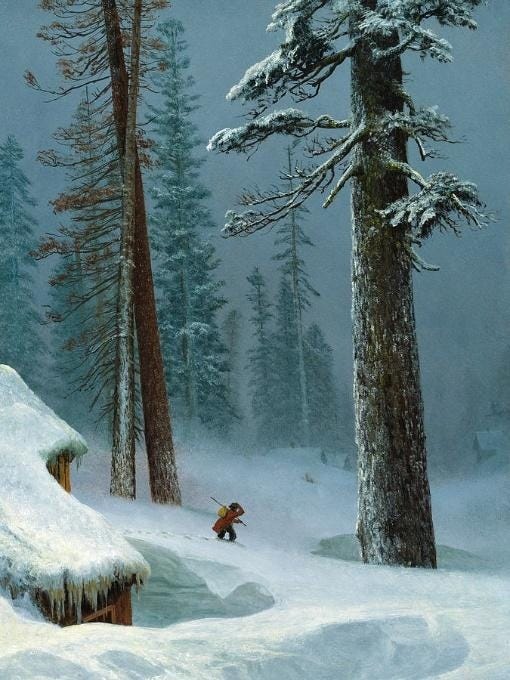
Thomistic scholars usually list beauty as one of the “three transcendental properties of being,” along with truth and goodness. Simply put, glimpsing truth, goodness, or beauty means glimpsing participation in the Divine. Though intelligibility of form is a condition of beauty, beautiful scenes might call to mind cosmic mysteries. Similarly, the majesty of a mountain or the vigor of a storm awakens a sense of the divine and our identity in relation to it. While Emerson and Thoreau flirted with pantheism, Christians do not equate creation with God, even while creation communicates something of God to us. As something created, the natural world is fundamentally “good,” as declared in Genesis. Therefore, the natural world possesses a value independent of the pleasure it affords us or the utility it provides. In The Abolition of Man, C.S. Lewis positions himself within the Thomistic tradition when he criticizes the authors of what he calls the Green Book. The authors of the Green Book claim that saying “that waterfall is sublime” is a statement about one’s feelings, not about the waterfall. Lewis spends the rest of The Abolition of Man refuting the Green Book’s implications. In short, a sublime waterfall might elicit humility and awe, but those feelings don’t make the waterfall sublime.
If the authors of the Green Book were right, we couldn’t make any value statements about anything except our own feelings. G.K. Chesterton called this idea the “thought that stops thought.” We do not project our own reality. We participate in reality. We are healthier and happier when our hearts and minds correspond to that reality. There are many reasons a person might fail to recognize a waterfall as sublime, but the waterfall remains sublime. Allowing our preferences to dictate reality is dangerous. The sublime landscapes of the Hudson River School might have evoked wonder in one observer and avarice in another. The issue is not that a railroad baron or gold prospector found economic value in the land, but that the pursuit of profit becomes disordered when it serves as the organizing principle in the life of an individual or a society.
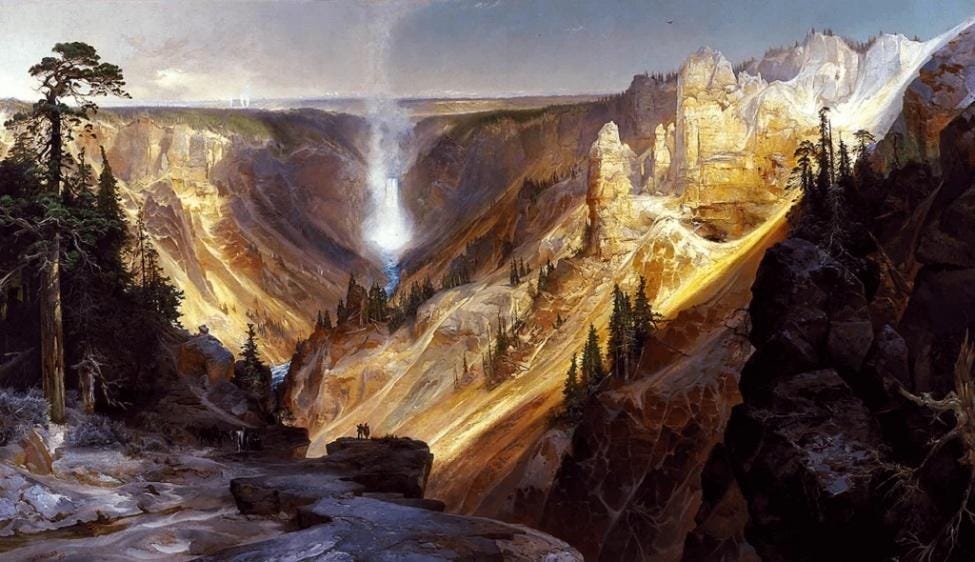
Art scholars, many of whom reject the Thomistic understanding, argue over the age-old question of “what makes good art?” I’ve asked myself this question when touring museum exhibits of modern art. I waver between two thoughts: “maybe I just don’t get it,” and “who the hell thinks this is good art?” Then again, art tends to mirror the culture. Thus, modern art has splintered into a multitude of movements that reflect our increasingly individualized culture, in which autonomy is the ultimate value, and all other values are relative, shirking any external authority beyond the self. In some cases, modern art has become so committed to subjectivity and abstraction that it abandons the imitation of reality altogether and, in doing so, dispenses with one or more of Aquinas’s conditions of beauty. Conversely, I stand with G.K. Chesterton when he wrote, “art is limitation; the essence of every picture is the frame. If you draw a giraffe, you must draw him with a long neck. If in your bold creative way you hold yourself free to draw a giraffe with a short neck, you will really find that you are not free to draw a giraffe.” In the words of Dr. Daniel McInerny, nature has rules or forms, and good art “re-presents, for our delighted contemplation, one or more formal aspects of its source or origin.” Importantly, imitation does not mean mere copying. McInerny writes, “When we realize that imitation is not foremost about resemblance but about re-presentation of form, we can welcome artistic experiments that sacrifice close resemblance for the sake of alerting us to the formal qualities of something that we might otherwise have been insensitive to.” Even cartoons can be beautiful if they retain some formal qualities of that which they depict.
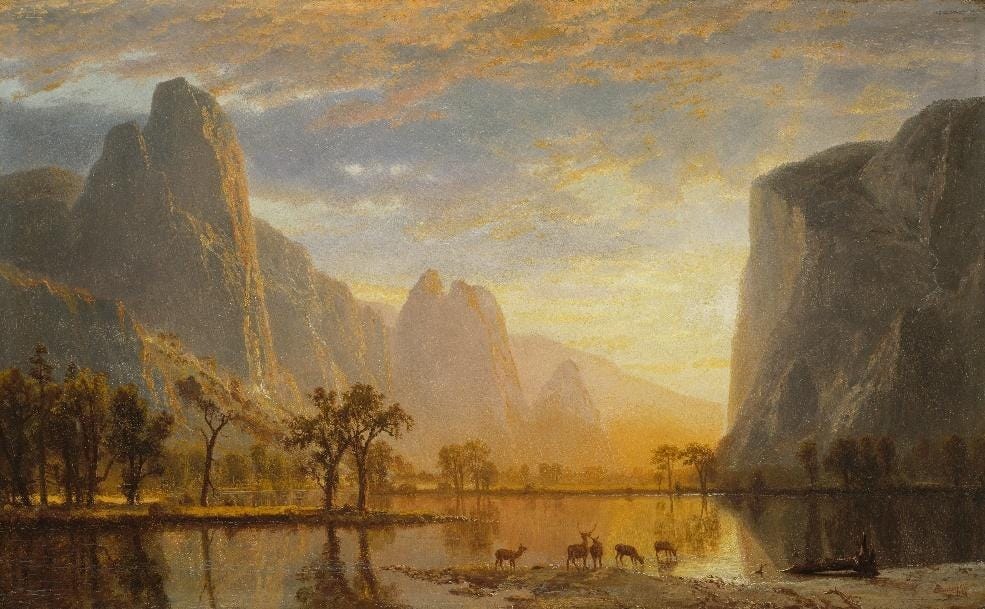
So, Hudson River School paintings are not merely attempts to copy a wilderness scene. They are re-presentations of such scenes which emphasize formal aspects that might otherwise remain unappreciated—light and shadow, perspective, scale, etc. I felt equally dumbstruck standing in a hallway of the Broadmoor Hotel as I have on any number of occasions on lofty peaks, wide-open prairies, or at the edge of desert canyons. Those paintings recall the experience of encountering the landscapes they portray, not because they perfectly reproduce them, but because they emphasize qualities worth contemplating.
As the Hudson River School gave way to tonalism and impressionism (though it inspired the later school of regionalism), the American conservation movement was just gaining steam. Figures like John Muir, George Bird Grinnell, and Teddy Roosevelt noticed the receding wilderness and wildlife that had been so abundant just one generation earlier. Aesthetic appreciation reinforced the conviction that American landscapes had value beyond their immediate economic utility. The Hudson River School played a major role in giving generations a visual language to communicate that value. The paintings continued to shape American ideas about wilderness and national identity. Roosevelt himself admired the Hudson River School and was likely acquainted with Albert Bierstadt (a member of the Boone and Crockett Club). Roosevelt went on to protect over 200 million acres of forests, wildlife refuges, and parks. The architects of the American conservation movement shared the painters’ appreciation for the grandeur of American landscapes. Their appetite for beauty drove their great achievements. While the paintings might have signaled manifest destiny to the prospectors, market hunters, and industrialists of the early to mid-nineteenth century, they also conveyed wonder and the sublime to Americans who witnessed the subsequent loss of ecological integrity. Through its beauty, the art invited a moral response, like Michelangelo’s Sistine Chapel or the Cathedral of Notre Dame.
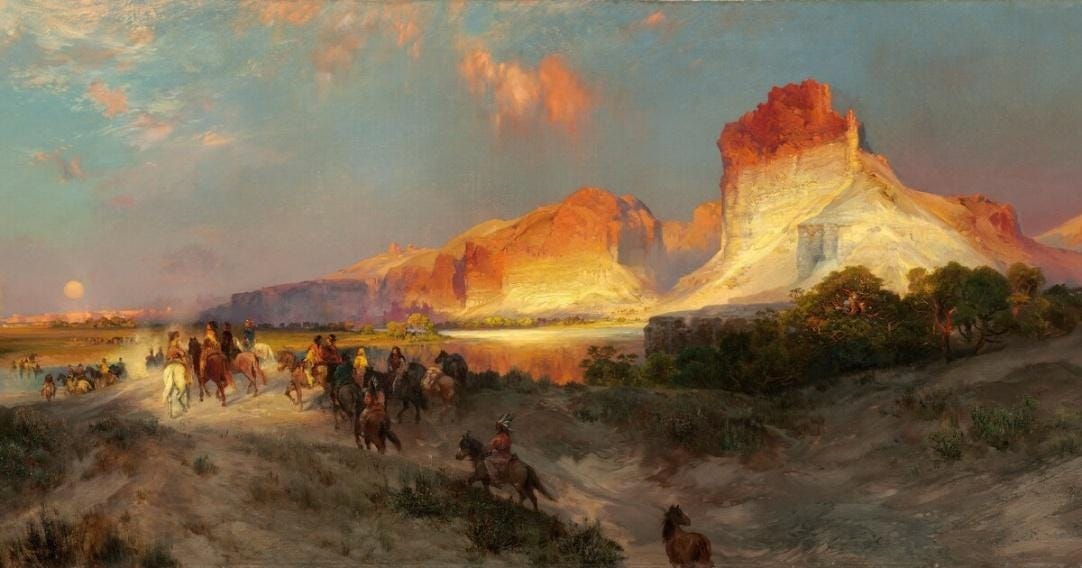
I was enchanted as we walked out of the Broadmoor Hotel. We had experienced “aesthetic arrest” at several points on the tour. The art stirred a nostalgia for lost American landscapes that bordered on grief. It also bolstered my passion for conservation. I had looked upon the same canvas as Teddy Roosevelt and John Muir, and I imagined it elicited the same response in them.
Benjamin Sisson is a graduate student at the University of Dayton and a veteran of the United States Army.