


By Brooke Ogles, Communications Associate at the American Conservation Coalition
Since becoming a parent, I’ve gained an affinity for monotony. My family thrives on a variety of routines. However, even the strictest routine cannot scratch my Type A brain quite like an upcoming trip, and ACC’s Summit is a trip I look forward to each year.
I take this preparation seriously. Packing lists are written in detail, points of interest, like the best coffees in town, are mapped out in advance, and PowerPoint presentations of wardrobe options are painstakingly edited for months beforehand, when even AccuWeather has nary an idea what the forecast could be (dress for the weather you want, I say!). It is no surprise, then, that I have never willingly checked a bag. Traveling strictly with a carry-on is a great exercise in self-control, restraint, and logic. The question is not “what is the least amount of clothing I can take to remain efficient?” though perhaps it should be. It sounds more like, “How can I Tetris all of my items around to fit my beloved set of hot rollers?”
This year’s exercise in logical practicality was completed with Elmo playing in the background while I appeased my 18-month-old daughter, who believed her toys were a travel necessity and entertained herself with her newly learned ability to somersault across the floor. She patiently watched as I arranged, rearranged, revised, and repacked my suitcase. When I finished, I had a perfectly organized carry-on and a pile of items on the bed of what I was leaving behind. Perfectly situated among these items was my daughter, the most important of them all, and the one thing that hurt most to leave behind.
Until this year, “leaving something behind” was a fairly ordinary phrase to me. It meant forgetting a pair of shoes I swore I needed, abandoning an old habit, or kissing my daughter goodbye before heading to the airport. After a close personal loss this spring, though, I began thinking differently about what, if anything, any of us choose to leave behind.
My daughter has her own method of leaving things behind: a sweet, toddler-sized mess of toys marking her presence that we have affectionately named the “Ruthie tornado.” I am not always appreciative of it, though I suspect I will miss it terribly someday.
We leave behind more than messes. We leave stories, recipes, cherished heirlooms, and traditions that we hope will give our loved ones a sense of comfort and familiarity once we have departed. After my Papa’s funeral this spring, I hastily picked flowers from his graveside and sent them to an extraordinary botanical preservationist to keep one last piece of him with us. He spoiled us throughout our childhood with roses from the bushes in his yard, and with these framed florals, each family member received one last parting gift from him.
Inheritance cannot always appear in a will. Some are recipes made from memory, stories retold around a dinner table, traditions carried into another generation, or places cared for because we believe someone else deserves to experience it someday. We spend our lives deciding what is worth carrying forward, ultimately determining what we will leave behind.
I carried that question with me to Medora: What are we choosing to leave behind, and what will the people who come after us carry forward?
The landscape surrounding the Theodore Roosevelt Presidential Library offered an answer. It is a living reminder of what generations of conservation can accomplish when people choose to care for something they will not ultimately keep for themselves.
Our farms, our public lands, our waters, and our wildlife are among our most important inheritances. Conservation does not exist to serve us alone; it serves generations still unborn. The defining question is not what we can take with us, but what we are willing to leave behind.
Our time in Medora offered a practical application of that idea from nearly every direction. Speakers approached conservation through policy, hunting, cooking, public lands, and the memory of Theodore Roosevelt’s legacy. The library reflects Roosevelt’s vision, and ultimately ACC’s, in its respect for carefully cultivated land that is used, not simply preserved.
We could not have received a clearer picture of that principle than we did at the opening reception. Medora’s finest Theodore Roosevelt impersonator stood in the very spot that originally enamored Roosevelt with the Badlands and recited the “Man in the Arena” speech.
Our members were tired. Medora is neither easy nor convenient to reach. But they could not have been more willing to stand in Roosevelt’s footsteps, listening to words written for another generation and carrying them into their own.


That spirit continued throughout the weekend. Our members at ACC are second to none. They are the heart of our conservation movement, doing the work on the ground and on a daily basis. They were engaged, asking deeply thoughtful questions of every speaker.
Then, at Saturday’s awards ceremony, we witnessed a rare phenomenon: there was absolutely no competition among nominees.
Members from every corner of the country were present. Some had just met that weekend, and others had known one another for years. Yet every nominee was earnestly cheered on, and our winners were genuinely celebrated. There was no visible jealousy or jockeying for attention, no sense that one person’s recognition diminished someone else’s accomplishments.
That sounds like a small thing. I do not think it is.
Conservation is necessarily intergenerational and collaborative. The work is too large, the timelines too long, and the stakes too high for any one person to claim ownership of it. The members in that room seemed to understand something easy to lose sight of in a culture increasingly organized around individual achievement: the point is not who gets to say they did it. The point is that it gets done.
To anyone reading this who worries about the future of conservation, I can assure you that the kids are alright.
Carrying on a legacy does not come easily, and our group of conservationists is well aware of the fact. Jeff Zausch sent members home with the challenge to live “the strenuous life.” He implored us to love and nurture the land, seeking to deeply understand it, to remain humble, and to be ready for more to be asked of them at any moment.
Our members took that charge with open hands. They were ready to take these lessons home to their cities, campuses, parks, and communities and make them better places than they found them.
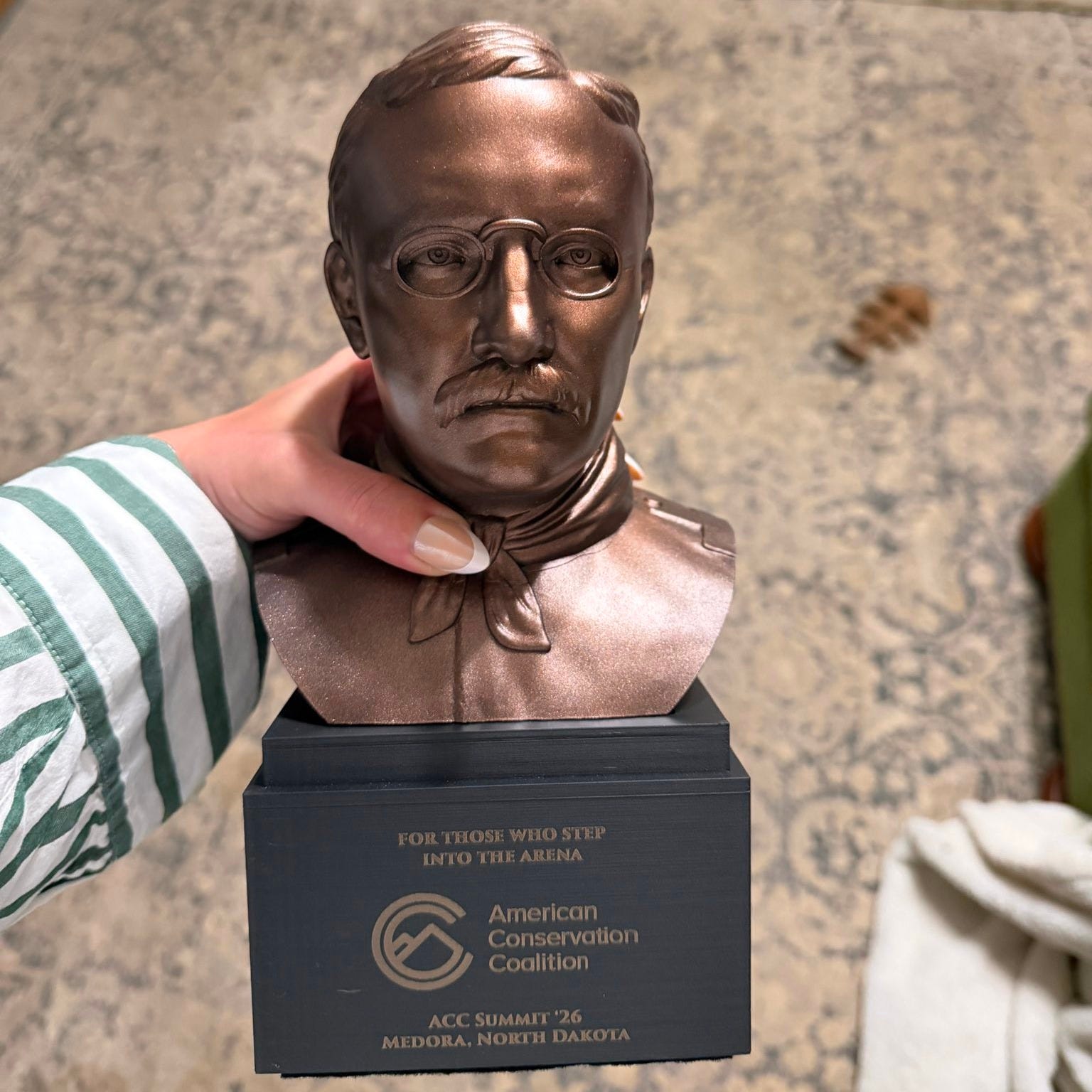
Each member received a glistening bust of Theodore Roosevelt, a sincere token of appreciation, but also a reminder of their charge. Roosevelt’s legacy is not theirs to simply admire. It is theirs to carry forward.
Eventually, the time did come to repack my carry-on. A bit tighter from some newly acquired items, including an official Teddy’s Bear for Ruthie, it required unconventional packing methods that sufficed to satisfaction upon fully zipping. Flights were boarded, and we left behind the landscape that had, quite frankly, changed many of us after a couple of days.
I thought again about the pile on my bed at home, and the things we decide are worth carrying and worth leaving behind.
Leaving something behind does not always mean abandoning it. Sometimes it means entrusting it to someone else.
That is the inheritance of conservation. The land does not belong to us, nor should it. We are temporary stewards of something far older than ourselves, with a responsibility to hand it to the next generation in better condition than we found it.
If Summit was any indication, I’m positive there is a generation ready to carry it on.
Brooke Ogles is the Communications Associate at the American Conservation Coalition. She is based in northeast Georgia.